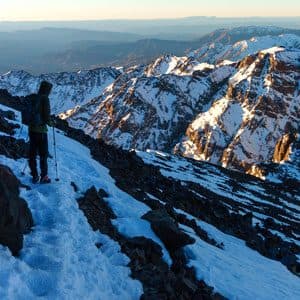
Mount Toubkal (4,167m) is the highest peak in the Atlas Mountains and the entire African continent north of the Sahara. Each year, thousands of trekkers make the ascent from the village of Imlil, and most are surprised by how accessible it is.
This is not a technical climb. No ropes, no crampons (in summer), no glacier travel. What it requires is good fitness, the right gear, and two days of your time. Here's exactly how it works.
The Route at a Glance
The standard route, the Toubkal Classic 2-Day, starts in Imlil village at 1,740m, roughly 60km south of Marrakech. Day one is a 5–7 hour trek up the Mizane Valley to the Toubkal Refuge at 3,207m. Day two is summit day: up through the South Cirque's scree slopes to the Tizi n'Toubkal col (3,940m), then along the summit ridge to the top.
Total ascent: 2,427 metres over two days. Total descent: the same, mostly on day two.
Do You Need a Guide?
Yes, by Moroccan law, all treks in Toubkal National Park must be accompanied by a licensed Moroccan mountain guide. Beyond legality, it's the right call: the trail is well-trodden but high-altitude sections involve route-finding on loose scree, and conditions can change fast. A guide who grew up in this massif is worth more than any app.
What Fitness Level Do You Need?
You should be able to hike 6–8 hours carrying a 10–12kg pack without stopping every 20 minutes. If you can do a long day hike at home with some elevation gain, Toubkal is within reach. Previous high-altitude experience is helpful but not essential for the summer route.
The biggest challenge isn't strength. It's the altitude. The summit day starts above 3,200m and tops out at 4,167m. Mild altitude headaches are common. The cure is to move slowly, drink 3–4 litres of water per day, and not rush the summit bid.
Best Time to Go
May to October is the trekking season for the standard route. June, July, and September offer the most reliable weather. July and August are peak season and can feel crowded around the refuge. May and October are quieter but carry a higher chance of lingering snow on the upper slopes.
Winter ascents (December–March) are possible but require crampons, ice axe, and winter mountaineering experience. They're classified as a separate, harder route.
What to Pack
Even in summer, temperatures at the Toubkal Refuge drop below 0°C at night and summit winds cut through light layers. Bring:
- Sturdy hiking boots with ankle support (broken in before the trip)
- Warm mid-layer and windproof outer shell
- Trekking poles, essential on the scree descent
- Headlamp for the pre-dawn summit start
- Sun protection: glacier glasses, sunscreen, hat
- 2–3 litres of water capacity
- High-energy trail snacks
The Toubkal Refuge
The CAF Refuge du Toubkal sits at 3,207m and sleeps around 70 people in dormitories. It serves hot food and drinks. Conditions are basic, bring a sleeping bag liner and earplugs. Booking ahead in July and August is strongly recommended; your guide will handle the reservation as part of your trek package.
On Summit Day
Expect a 4:30–5:00am start. The pre-dawn departure is deliberate: you want to reach the summit by 8–9am before afternoon clouds build. The South Cirque's scree requires patience, there's no shortcut. The final ridge is narrow, exposed to wind, and gives you the first full view of the summit cairn.
At the top: the Atlas stretches in every direction. On a clear day you'll see the Saharan plains to the south. Most summiteers spend 20–30 minutes on top before beginning the long descent back to Imlil.
How to Book
The Toubkal Classic 2-Day trek with Toubkal Wanderers runs from €150–€220 per person and includes a licensed local guide, Toubkal Refuge accommodation, and meals on the trail. No deposit required until confirmation.
Message us on WhatsApp (+212659973883) to check availability and plan your dates.